Imagine a world where you can borrow money directly from people instead of waiting in long bank queues, or where your savings can earn higher returns by helping someone achieve their dreams. That’s exactly what peer-to-peer (P2P) lending does it brings borrowers and lenders together on a single platform, cutting out the middleman.
Also called social lending or crowdlending, P2P lending is not just another financial trend; it’s a smart, modern way to manage money. Borrowers can often access loans at lower interest rates, while lenders get a chance to earn better returns than traditional savings options.
Peer-to-peer (P2P) lending might sound complex, but the process is straightforward and transparent. Here’s a step-by-step look at how borrowers and lenders connect and make the magic happen:
Both borrowers and investors start by creating an account on a P2P lending platform. These platforms act as the middle ground, ensuring secure transactions and smooth communication between parties.
Platforms include:
Example
Borrowers submit key details such as:
The platform evaluates the borrower’s creditworthiness and assigns a risk category, which influences the interest rate offered.
Example
Income: ₹50,000/month
Credit score: 720
Loan purpose: Buy ovens and raw materials
Investors browse available loan requests and can fund loans that match their risk appetite and expected returns. Many platforms allow a single loan to be split among multiple lenders, spreading the risk while still generating steady returns.
Example
Once a match is made, a legally binding loan agreement is signed. Funds are then transferred to the borrower, and the platform ensures all repayments are tracked and distributed back to lenders automatically.
Example
Principal invested: ₹20,000
Interest rate: 14% p.a.
Tenure: 12 months
Borrowers repay their loans in monthly installments through the platform, making it easy for lenders to track payments and for borrowers to stay on schedule.
Example
Principal portion: ₹1,667
Interest portion: ₹250
Total monthly payment received: ₹1,917
Loan Completion & Returns
Example
Bonus: Social Impact P2P Lending. Some platforms, like Kiva, go beyond profits. They focus on empowering underserved communities and entrepreneurs, providing funding to people who might not qualify for traditional loans. This makes P2P lending not just profitable, but also purpose-driven.
Faircent is India’s leading peer-to-peer (P2P) lending platform, registered as an NBFC-P2P by the Reserve Bank of India (RBI). It connects borrowers and lenders directly through a fully digital marketplace, eliminating traditional banks as intermediaries.
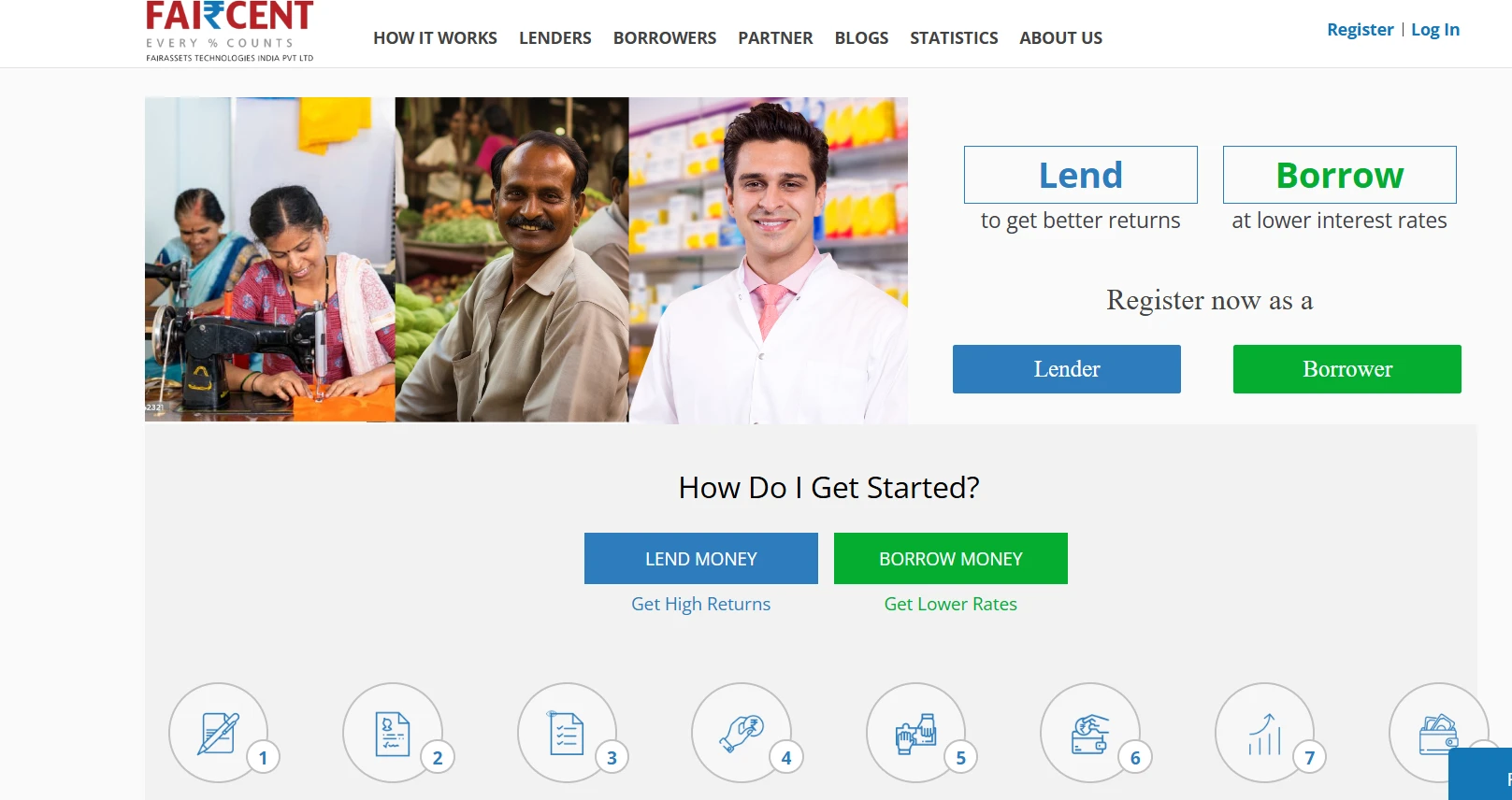
Faircent acts as a digital credit marketplace, offering easy access to credit for borrowers and better returns for lenders. It’s transforming the way individuals borrow and lend money in India.
Peer-to-peer (P2P) loans aren’t just for emergencies they’re a flexible financial tool that can help you achieve your goals faster. Here are some of the most popular ways borrowers use them:
Juggling multiple debts can be stressful. With a P2P loan, you can combine several debts into one manageable payment, often at a lower interest rate, giving your finances some breathing room.
Want to renovate your kitchen, upgrade your bathroom, or add that cozy balcony? P2P loans make it possible to fund home improvements without dipping into your savings.
Unexpected health expenses can hit hard. P2P lending provides quick access to funds, helping you focus on recovery instead of worrying about bills.
Whether it’s tuition, online courses, or professional certifications, a P2P loan can be the bridge to achieving your educational dreams without burdening your family.
Small businesses and startups can use P2P loans to grow, expand, or invest in new opportunities. It’s a smart way to get capital without traditional bank red tape.
P2P loans are flexible, think of them as a tool to unlock possibilities rather than just cover expenses. From personal goals to professional ambitions, the right loan can make things happen faster.
P2P lending is fast, flexible, and transparent, making it a modern choice for borrowers and investors alike.
P2P lending blends speed, transparency, and mutual advantage, making it a modern solution for both borrowers and investors.
Diversify your lending portfolio across multiple borrowers to mitigate risks.
P2P lending isn’t just for banks or big institutions its almost anyone can become a lender.
Here’s who can participate:
Whether you’re a newbie or a seasoned investor, P2P lending lets you put your money to work smarter, all while helping borrowers achieve their goals.
These platforms serve personal, business, consumer, and real estate financing, often with robust risk management tools like credit scoring beyond traditional metrics and buyback guarantees.
In India, P2P lending is regulated by the RBI, ensuring safer operations for borrowers and investors. Popular platforms include:
Some loans offer up to 30% per annum interest, with recovery support for defaults.
These platforms offer competitive interest rates, flexible loan terms, and diverse risk-return options, catering to both individual borrowers and small businesses.
P2P lending is an online platform connecting borrowers directly with lenders, bypassing banks for faster, flexible loans.
Borrowers post loan requests, lenders fund them, and the platform manages agreements and repayments.
Loans are not government-insured, but regulated platforms (like RBI-approved ones in India) offer added safety.
Anyone individual investors, wealth managers, or funds often starting with as little as $25.
Individuals, freelancers, students, and small businesses, including those underbanked or first-time borrowers.
Debt consolidation, home renovation, medical emergencies, education, or business expansion.
Use trusted, regulated platforms, start small, diversify, and track repayments regularly.
Imagine a world where you can borrow money directly from people instead of waiting in long bank queues, or where your savings can earn higher returns by helping someone achieve their dreams. That’s exactly what peer-to-peer (P2P) lending does it brings borrowers and lenders together on a single platform, cutting out the middleman.
Also called social lending or crowdlending, P2P lending is not just another financial trend; it’s a smart, modern way to manage money. Borrowers can often access loans at lower interest rates, while lenders get a chance to earn better returns than traditional savings options.
Peer-to-peer (P2P) lending might sound complex, but the process is straightforward and transparent. Here’s a step-by-step look at how borrowers and lenders connect and make the magic happen:
Both borrowers and investors start by creating an account on a P2P lending platform. These platforms act as the middle ground, ensuring secure transactions and smooth communication between parties.
Platforms include:
Example
Borrowers submit key details such as:
The platform evaluates the borrower’s creditworthiness and assigns a risk category, which influences the interest rate offered.
Example
Income: ₹50,000/month
Credit score: 720
Loan purpose: Buy ovens and raw materials
Investors browse available loan requests and can fund loans that match their risk appetite and expected returns. Many platforms allow a single loan to be split among multiple lenders, spreading the risk while still generating steady returns.
Example
Once a match is made, a legally binding loan agreement is signed. Funds are then transferred to the borrower, and the platform ensures all repayments are tracked and distributed back to lenders automatically.
Example
Principal invested: ₹20,000
Interest rate: 14% p.a.
Tenure: 12 months
Borrowers repay their loans in monthly installments through the platform, making it easy for lenders to track payments and for borrowers to stay on schedule.
Example
Principal portion: ₹1,667
Interest portion: ₹250
Total monthly payment received: ₹1,917
Loan Completion & Returns
Example
Bonus: Social Impact P2P Lending. Some platforms, like Kiva, go beyond profits. They focus on empowering underserved communities and entrepreneurs, providing funding to people who might not qualify for traditional loans. This makes P2P lending not just profitable, but also purpose-driven.
Faircent is India’s leading peer-to-peer (P2P) lending platform, registered as an NBFC-P2P by the Reserve Bank of India (RBI). It connects borrowers and lenders directly through a fully digital marketplace, eliminating traditional banks as intermediaries.
Faircent acts as a digital credit marketplace, offering easy access to credit for borrowers and better returns for lenders. It’s transforming the way individuals borrow and lend money in India.
Peer-to-peer (P2P) loans aren’t just for emergencies they’re a flexible financial tool that can help you achieve your goals faster. Here are some of the most popular ways borrowers use them:
Juggling multiple debts can be stressful. With a P2P loan, you can combine several debts into one manageable payment, often at a lower interest rate, giving your finances some breathing room.
Want to renovate your kitchen, upgrade your bathroom, or add that cozy balcony? P2P loans make it possible to fund home improvements without dipping into your savings.
Unexpected health expenses can hit hard. P2P lending provides quick access to funds, helping you focus on recovery instead of worrying about bills.
Whether it’s tuition, online courses, or professional certifications, a P2P loan can be the bridge to achieving your educational dreams without burdening your family.
Small businesses and startups can use P2P loans to grow, expand, or invest in new opportunities. It’s a smart way to get capital without traditional bank red tape.
P2P loans are flexible, think of them as a tool to unlock possibilities rather than just cover expenses. From personal goals to professional ambitions, the right loan can make things happen faster.
P2P lending is fast, flexible, and transparent, making it a modern choice for borrowers and investors alike.
P2P lending blends speed, transparency, and mutual advantage, making it a modern solution for both borrowers and investors.
Diversify your lending portfolio across multiple borrowers to mitigate risks.
P2P lending isn’t just for banks or big institutions its almost anyone can become a lender.
Here’s who can participate:
Whether you’re a newbie or a seasoned investor, P2P lending lets you put your money to work smarter, all while helping borrowers achieve their goals.
These platforms serve personal, business, consumer, and real estate financing, often with robust risk management tools like credit scoring beyond traditional metrics and buyback guarantees.
In India, P2P lending is regulated by the RBI, ensuring safer operations for borrowers and investors. Popular platforms include:
Some loans offer up to 30% per annum interest, with recovery support for defaults.
These platforms offer competitive interest rates, flexible loan terms, and diverse risk-return options, catering to both individual borrowers and small businesses.
P2P lending is an online platform connecting borrowers directly with lenders, bypassing banks for faster, flexible loans.
Borrowers post loan requests, lenders fund them, and the platform manages agreements and repayments.
Loans are not government-insured, but regulated platforms (like RBI-approved ones in India) offer added safety.
Anyone individual investors, wealth managers, or funds often starting with as little as $25.
Individuals, freelancers, students, and small businesses, including those underbanked or first-time borrowers.
Debt consolidation, home renovation, medical emergencies, education, or business expansion.
Use trusted, regulated platforms, start small, diversify, and track repayments regularly.
A contributor to the Finanjo blog, where I share insightful and easy-to-understand content focused on educating readers about finance. With a clear and approachable writing style, I simplify complex topics to make them more understandable.
A contributor to the Finanjo blog, where I share insightful and easy-to-understand content focused on educating readers about finance. With a clear and approachable writing style, I simplify complex topics to make them more understandable.

